GivingForce Intelligence · White paper
The four stages
of AI in
corporate giving
How AI arrives in giving and volunteering programmes, one stage at a time. What the data says at each stage, where we'd draw the line between helping someone and deciding for them, and the two questions we haven't yet seen anyone in the sector answer.


By Ejaz Rashid, founder and CEO, and Michael Daley, head of productAbout 25 minutes · 11 interactive exhibits · filmed clips

- 1It explains
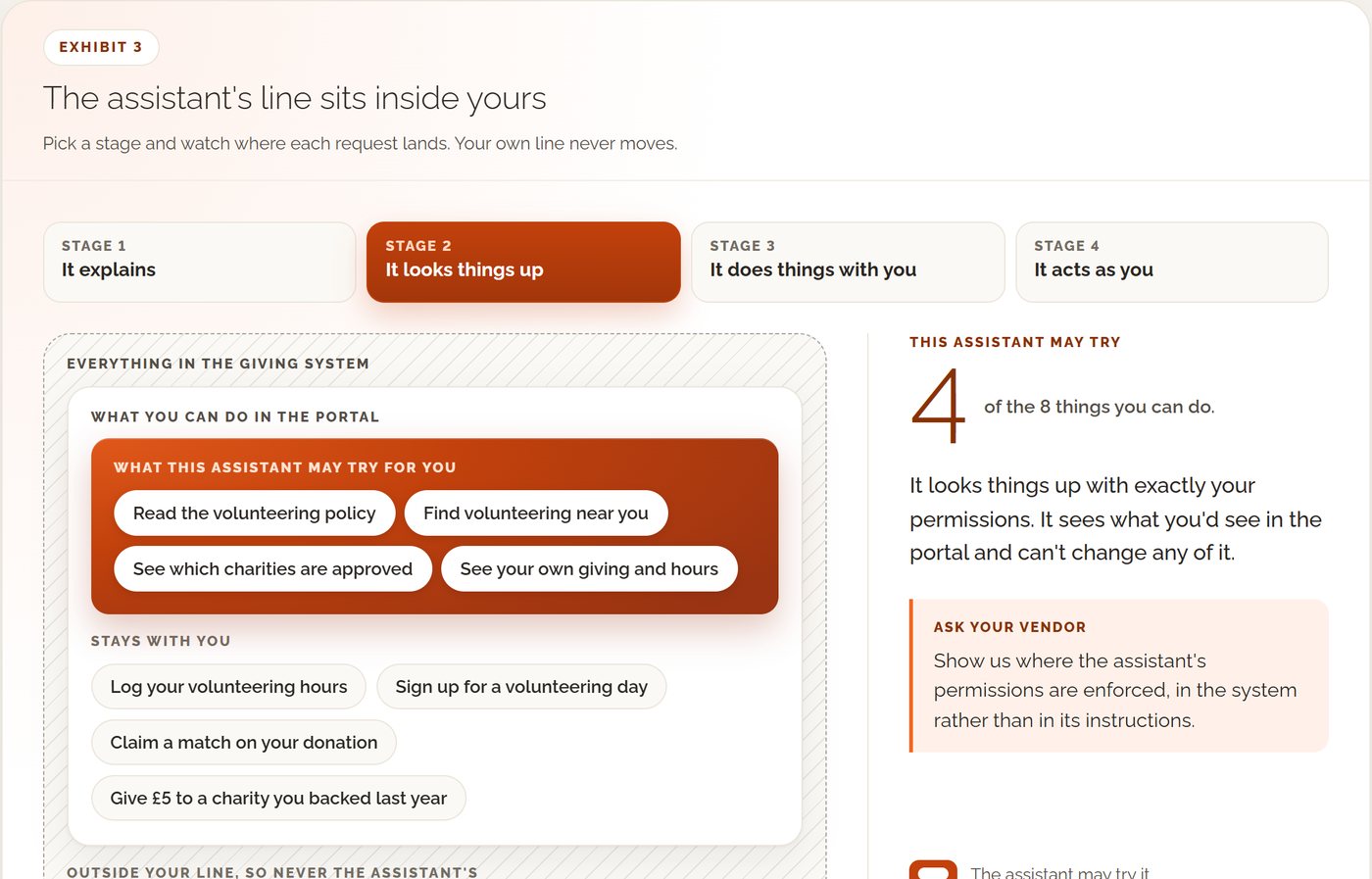
- 2It looks things up
- 3It does things with you
- 4It acts as you
What the numbers say
The data behind each stage
Every stage chapter has a sourced panel on participation, assistants at work and governance. A few of the figures:
- 26%
- of the paid volunteering days UK employers offer are actually taken.1,000 UK HR decision makers, RVS and Cebr, 2025
- 71%
- of UK employees have used AI tools their employer hasn't approved.2,003 UK employees, Microsoft UK, 2025
- 25%
- of employees, on average, take part in their company's volunteering programme.Companies surveyed by CECP, 2025 data
Inside the paper
Seven things this paper argues
Where we're confident, it says so. Where people inside GivingForce disagree, it says that too.
- 01AI is a discovery channel before it's an intelligence channel.The most common problem in giving programmes is that people can't find them. The first job for an assistant is getting people there.
- 02Governance got there before the products did.Large employers can assess an AI use case before most giving vendors are ready to be assessed.
- 03AI arrives in giving in four stages.Each stage stands on its own, and an organisation can stay at stage 1 for good.
- 04The assistant should see what the employee sees, and nothing more.Then it should be narrowed again by what this particular tool may attempt.
- 05Being able to do something and being allowed to do it are separate questions.Write the reason into every rule.
- 06Automate the navigation. Keep the person in the judgement.Identity, eligibility and the words in someone's volunteering story stay with them.
- 07Two questions are open, and we'd rather publish them than pretend.Who answers for it when an assistant gets it wrong? And does a programme that runs entirely through an assistant still do the job it exists for?
Three of the eleven exhibits
Not a PDF. A paper you can try.
Each exhibit runs in your browser. Pick a stage, play a conversation, move a line and see what changes.
-
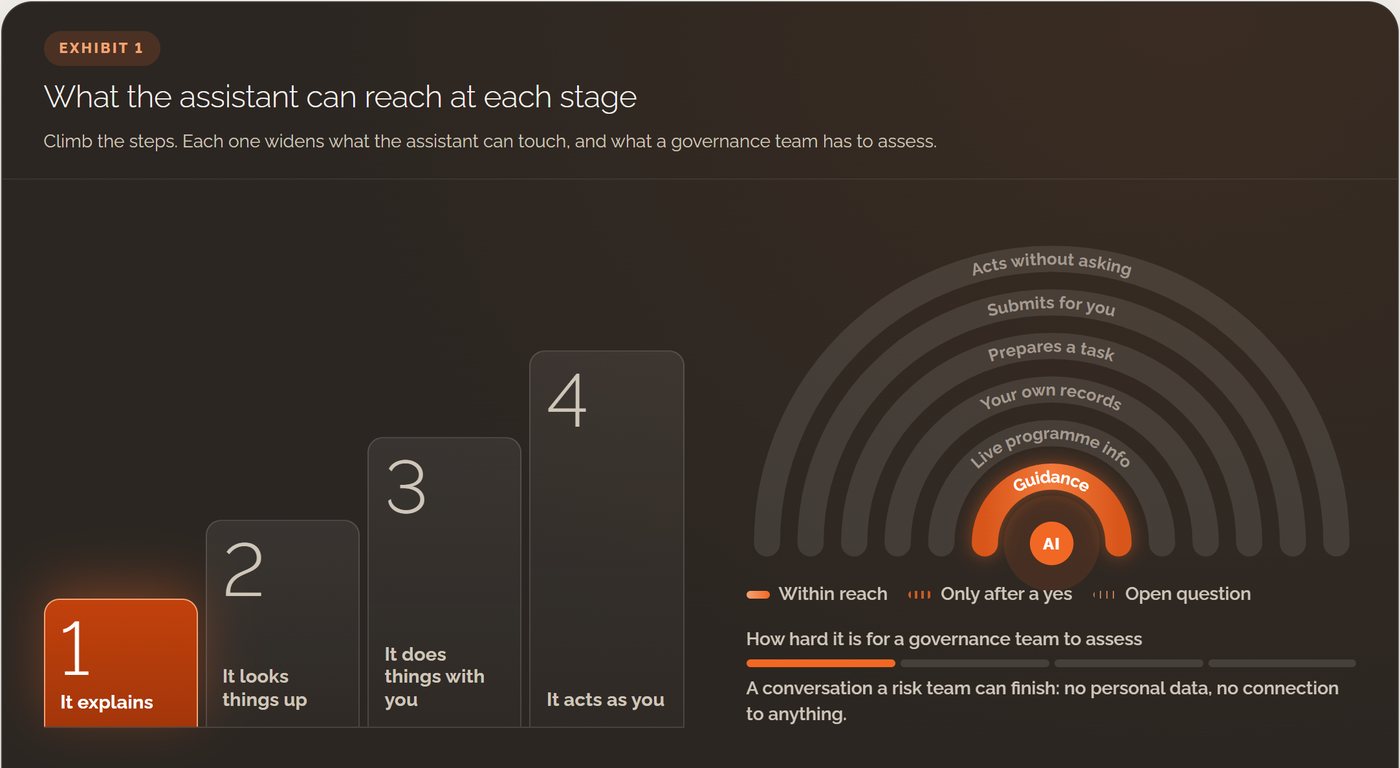 Exhibit 1
What the assistant can reach at each stage
Climb the steps. Each one widens what the assistant can touch, and what a governance team has to assess.
-
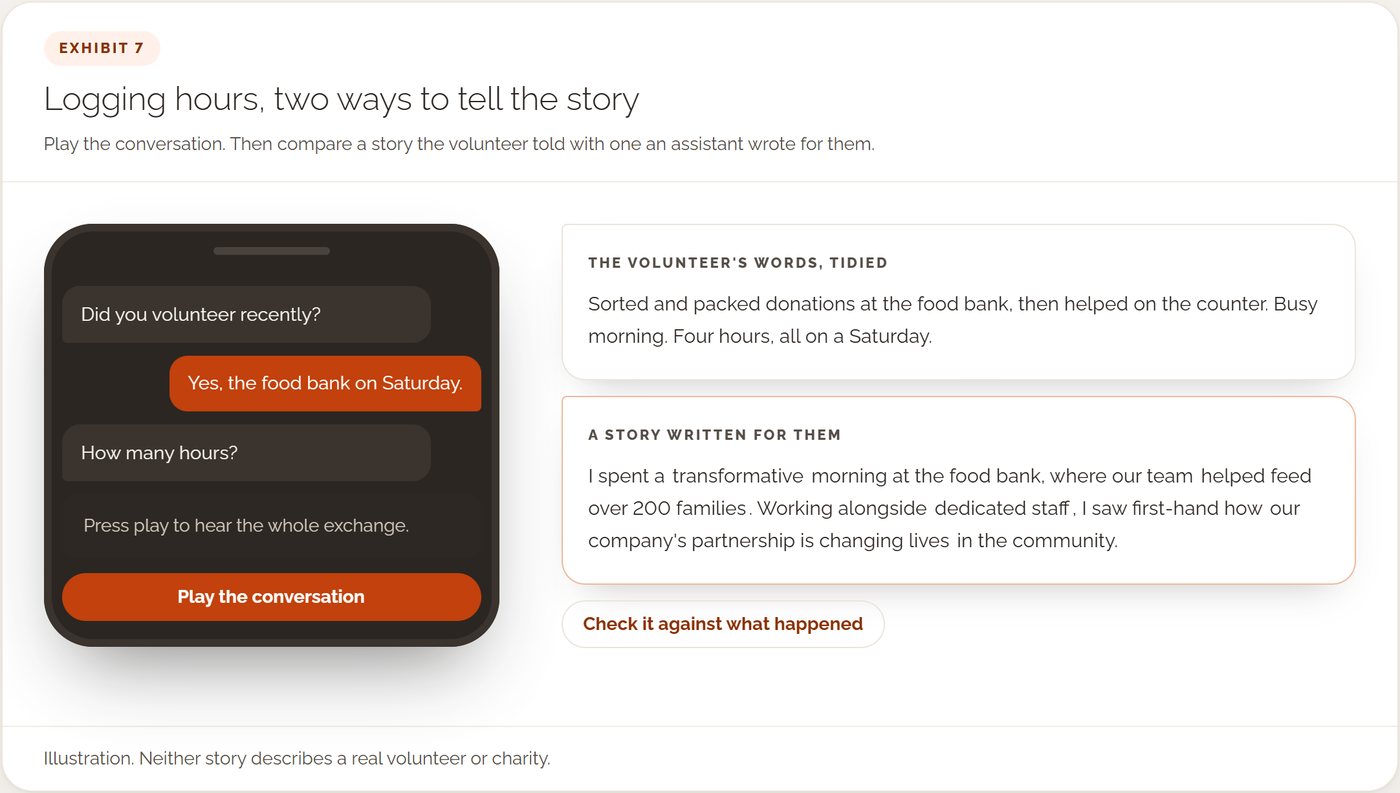 Exhibit 7
Logging hours, two ways to tell the story
Play the conversation, then compare the volunteer's own words with a story an assistant wrote for them.
-
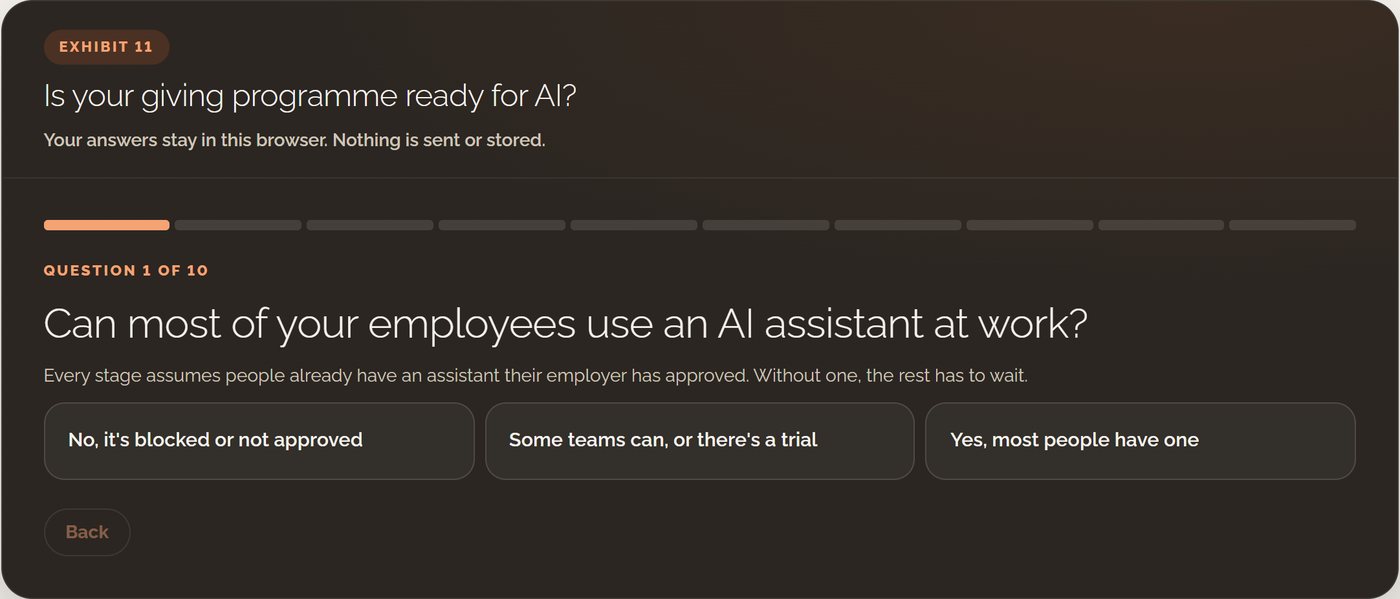 Exhibit 11
Is your giving programme ready for AI?
Ten questions. Your answers stay in your browser, and nothing is sent or stored.
Filmed for the paper
A conversation between Ejaz Rashid and Michael Daley
Recorded for the paper. Clips from it run through every chapter, so you hear the argument from the people making it.
"Would you ever want it to make a donation on your behalf?"Ejaz RashidFounder and CEO, GivingForce · 0:29
"It seems like magic to us right now, but in reality it's just going to be common life."Michael DaleyHead of product, GivingForce · 0:26
16
more clips from the conversation, placed in the chapters they belong to.
Read the paper to watch themThis is GivingForce's point of view on how AI arrives in corporate giving. It isn't a product announcement, and nothing in it is a date or a promise.
If you think we've drawn a line in the wrong place, tell us.
Read the paper, try the exhibits, then come and argue it with us.
Read the white paper
We'll use your details to give you the paper and to send occasional GivingForce updates. You can unsubscribe at any time. See our privacy policy.